

The cuerda bondage is the only accessory in this section that does not forgive improvisation. A padded handcuff spreads the pressure by design; A rope does exactly what you tell it to do, and that's both its appeal and its risk.
Restraints & Bondage Foundations | Impact Play | Hoods, Masks & Blindfolds | Sensory & Roleplay Control
Standard measurements and why they exist
In tying practice, two figures have been standardized, and knowing them avoids purchasing useless material.
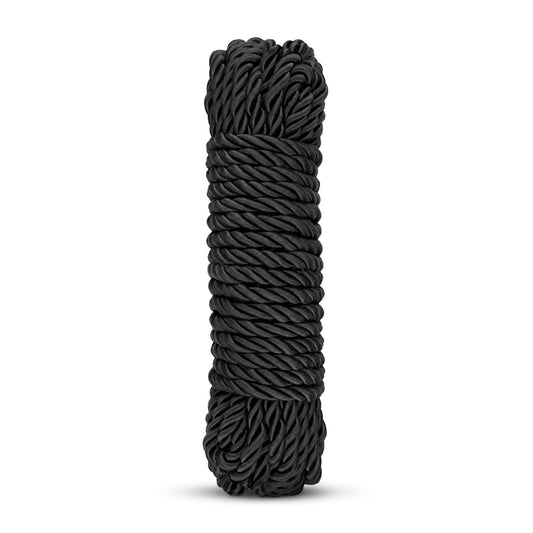
The usual thickness is 6 millimeters. Below 5 millimeters the rope digs in and concentrates pressure on a very fine line, which is just what to avoid. Above 8 millimeters it is rigid and difficult to tie accurately.
The reference length is 7 to 8 meters per piece. That measurement is not arbitrary: it is what allows most torso bindings to be completed without splices, folded in half. A reasonable starting set is two or three ropes of that length, plus a short one of three or four meters for wrists and ankles.
The materials, one by one
- Algodón. Gentle from the first use, non-irritating and the most forgiving to begin with. It loosens a little with tension, which is an advantage when learning.
- Yute y cáñamo. The traditional ones of cuerda shibari. They have a natural grip, the knots do not slip and they transmit a very characteristic texture sensation. They require prior preparation and are not washed in water.
- Nailon. Resistant, machine washable and with a silky touch. Its drawback is that it is slippery, so the knots tend to tighten on their own under tension, and that makes it less recommended for those starting out.
- Cinta adhesiva de bondage. It is not adhesive on the skin, it only adheres to itself. It is the fastest option and the only one that does not require knowing knots.
Where it is tied and where it is not
This is the part that no catalog includes and the one that matters most.
Safe areas are those with muscle mass or bone structure underneath: wrists with wide laps, forearms, thighs, torso over the rib cage.
The areas to avoid are the armpits, the inside of the arm near the elbow, the side of the neck, the crook of the knee and the hollow of the groin. They are points where nerves and vessels pass superficially, and there sustained pressure can leave consequences for days or weeks.
And the collar is never tied, under any configuration. Also do not leave a rope that passes near the neck if there is a possibility of the person moving.
The rules of a session
Always spread the pressure over several turns instead of just one. Three or four parallel wraps on one wrist are much more comfortable and safer than a single tight one.
Check with two fingers: they should pass between the rope and the skin without forcing. Check the temperature, color and sensitivity of your hands and feet every ten or fifteen minutes. If tingling, numbness, paleness or cold appear, let go immediately and without discussion.
Have emergency scissors on hand, with the blunt tip and curved blade, before making the first turn. Not after. And the tied person is not left alone for a moment.
Suspended tying is outside of what can be learned in writing, and should not be attempted without in-person training.
Material care
Cotton and nylon are washed in a mesh bag, in cold water, and dried stretched or hung. Jute and hemp are not washed by immersion: they are dry cleaned and treated from time to time with specific oil to keep the fiber flexible.
Store ropes wound into a skein, never in a tight ball, and check them before each use for frayed or thinned areas.
The rest of the range
If you'd rather start with something that already distributes pressure by design, check out Handcuffs & Restraints. Full sets are at Bondage Kits & Sets, necklaces at Collars & Chokers, and the general category at Restraints & Bondage Foundations.
The materials, compared
Each material behaves differently in the knot, in the skin and in the time it lasts. This is the quick reference.
| Materials | Touch | Knot Grip | Reusable | Level |
|---|---|---|---|---|
| Cotton | Soft | Good | Yes | Initial |
| Jute | Rough | Very good | Yes, with maintenance | Advanced |
| Nylon | Silky | Loosens | Yes | Intermediate |
| Adhesive bondage tape | Smooth | Hits herself | Single use | Initial |
| Silicone tape | Soft | Adheres without glue | Yes | Initial |
The buckled and padded alternatives are at Restraints & Bondage Foundations, and the sensory pieces that usually accompany them are at Hoods, Masks & Blindfolds.
Discreet shipping from Lace & Luna
Plain packaging without brand or reference to the content, discreet bank charge, preparation in 1 or 2 working days and delivery in the UK between 3 and 7 working days, with free shipping over €100. Exclusive sale for people over 18 years of age.
Frequently asked questions
Which rope is best to start with?
Six millimeter cotton in sections of seven to eight meters. It is soft, holds the knot well, and is more forgiving of tension errors than jute.
Where is it never tied?
On the neck, in no case. Nor on joints or on the inside of the arm or thigh, where the nerves pass close to the surface.
###How do you know if it's too tight?
A finger should fit between the rope and the skin. If tingling, cold or color change appears, release immediately.
What should you always have on hand?
A pair of blunt-tipped scissors or a string cutter, and an agreed-upon word or gesture to stop. No one is ever left tied up without company.
How do you take care of the rope?
Cotton is hand washed and dried flat. Jute is not washed: it is brushed, put through gentle heat and stored rolled up in a dry place.
-
Rope Set – Luxury Bondage Ropes | Rosy Gold
Regular price £45.00 GBPRegular price -
Restrain Me Bondage Ropes – 2×5 Metres | Fifty Shades Of Grey
Regular price £20.00 GBPRegular price -
Kinbaku Bondage Rope Cotton 5m | Bedroom Fantasies
Regular price £27.00 GBPRegular price -
Sex & Mischief Silky Rope Kit | Sportsheets
Regular price £13.00 GBPRegular price -
10m Bondage Tape | Bedroom Fantasies
Regular price £22.00 GBPRegular price -
Knot in Control 10m Silky Bondage Rope | Sei Mio
Regular price £11.00 GBPRegular price -
Fetish Bondage Rope 10m | EasyToys
Regular price £35.00 GBPRegular price -
Fetish Hemp Bondage Rope 10M | EasyToys
Regular price £35.00 GBPRegular price -
Fetish Bondage Rope 5m | EasyToys
Regular price £28.00 GBPRegular price -
Fetish Hemp Bondage Rope 5M | EasyToys
Regular price £28.00 GBPRegular price




Not available for UK delivery
This brand currently ships from the EU and isn't available for UK delivery. Browse UK-available brands.
You may also like
-
Fantasy Series Fantasy Deluxw Door Swing | Fetish
Regular price £54.00 GBPRegular price -
Cuffs | Quickie
Regular price From £9.00 GBPRegular price -
XR Brands Inhaler Gas Mask with Bottle Black & | Master Series
Regular price £147.00 GBPRegular price -
Under Mattress Restraint Set | Bedroom Fantasies
Regular price £52.00 GBPRegular price -
Kinbaku Bondage Rope Cotton 5m | Bedroom Fantasies
Regular price £27.00 GBPRegular price -
Bondage Suitcase 13 Pcs Cow Leather | Bedroom Fantasies
Regular price £326.00 GBPRegular price -
Pretty Thighed Up Thigh Wrist and Ankle Restraint | Sei Mio
Regular price £28.00 GBPRegular price -
Knot in Control 10m Silky Bondage Rope | Sei Mio
Regular price £11.00 GBPRegular price -
Areola Grande Teasing Nipple Suckers | Sei Mio
Regular price £7.00 GBPRegular price -
Fetish Metal Mask | EasyToys
Regular price £64.00 GBPRegular price -
Fetish Fantasy Series - Series Position Master with Cuffs
Regular price £45.00 GBPRegular price -
Fetish Fantasy Series - Ultra Inflatable Position Master
Regular price £46.00 GBPRegular price -
Hydro 7 Penis Pump | Bathmate
Regular price £76.00 GBPRegular price -
Gauntlets Fisting Gloves | Buttr
Regular price £51.00 GBPRegular price -
S&M Elastabind Corset Restraint | Sex & Mischief
Regular price £15.00 GBPRegular price -
S&M Amor Blindfold | Sex & Mischief
Regular price £9.00 GBPRegular price -
S&M Fishnet Ball Gag | Sex & Mischief
Regular price £16.00 GBPRegular price -
S&M Door Play Kit | Sex & Mischief
Regular price £18.00 GBPRegular price -
S&M Wrist & Ankle Restraints | Sex & Mischief
Regular price £18.00 GBPRegular price -
S&M Black Day Collar | Sex & Mischief
Regular price £13.00 GBPRegular price -
SXY Cuffs Deluxe Neoprene Cross Cuffs FRENCH | CC Games
Regular price £16.00 GBPRegular price -
Bondage Tape Hot | CC Games
Regular price £5.00 GBPRegular price -
Sex Ties & Bondage Tape | CC Games
Regular price £5.00 GBPRegular price -
Tie Her Up Tape Hen Hot | CC Games
Regular price £4.00 GBPRegular price -
Hoodwinked and Kinked Deprivation Hood with Blackout Panel | Sei Mio
Regular price £14.00 GBPRegular price -
Cross the Threshold Door Based Bondage Cross System | Sei Mio
Regular price £42.00 GBPRegular price -
Booty Booster Cuff-Ready Padded Positioning Wedge | Sei Mio
Regular price £56.00 GBPRegular price -
Roundly Chastised Paddle | Sei Mio
Regular price £14.00 GBPRegular price -
Majestic Mount Cuff-Ready Queening and Positioning Stool | Sei Mio
Regular price £56.00 GBPRegular price -
Complete Surrender The Ultimate Bed Tether Seduction Set | Sei Mio
Regular price £56.00 GBPRegular price -
Eyes Wide Shut Soft Velvet Blindfold | Sei Mio
Regular price £7.00 GBPRegular price -
Cocked and Loaded- Advanced Strap-On Harness and 6.5” Dildo | Sei Mio
Regular price £39.00 GBPRegular price -
Delectable Domination Supreme Hog Tied Submissive Play Set | Sei Mio
Regular price £49.00 GBPRegular price -
Correction Collection Impactful 5 Piece Punishment Toolkit | Sei Mio
Regular price £49.00 GBPRegular price -
Studdy Hard Paddle | Sei Mio
Regular price £14.00 GBPRegular price -
Sex & Mischief Silky Sash Restraints | Sportsheets
Regular price £28.00 GBPRegular price -
Leather Impression Paddle – Slut | Sportsheets
Regular price £34.00 GBPRegular price -
Gigolo Fuck Machine | F-Machine
Regular price £610.00 GBPRegular price -
Sex & Mischief Furry Handcuffs | Sportsheets
Regular price £16.00 GBPRegular price -
Plungers Nipple Suckers | XR Brands
Regular price £36.00 GBPRegular price -
TENSION LOVER | Mystim
Regular price £139.00 GBPRegular price -
Sultry Sub Receiver Channel | Mystim
Regular price £57.00 GBPRegular price -
NOTHING BUT SENSATION Nipple Teasers | Fifty Shades Of Grey
Regular price £13.00 GBPRegular price -
Behind Closed Doors Door Hanging Sex Swing | Sei Mio
Regular price £46.00 GBPRegular price -
Total Eclipse Deluxe Blackout Mask | Sei Mio
Regular price £14.00 GBPRegular price -
Slap and Tickle Crop | Sei Mio
Regular price £11.00 GBPRegular price -
Flexing Flavio | Mystim
Regular price £55.00 GBPRegular price -
Keep Still Bed Restraint Set | Fifty Shades Of Grey
Regular price £55.00 GBPRegular price


